

Why Choosing the Wrong Footwear Turns Wet Rock Into an Unforgiving Hazard
The idea of one do-it-all amphibious shoe is attractive, especially when a route moves between river shallows, polished slabs, muddy banks and dry approaches. In practice, wet terrain changes too quickly for a single design to excel everywhere. A lightweight water shoe may feel agile in a kayak or packraft, yet offer little protection when a foot wedges between boulders. A robust wading boot may support the ankle well, but feel cumbersome during a swim section or a long approach walk.
Water adds more than slipperiness. Current pushes against the lower leg, submerged biofilm reduces friction, and shifting silt can hide holes, loose stones and sharp edges. Cold water also turns small design compromises into fatigue. Choose footwear by reading the environment first, then match the sole, drainage system, ankle structure and foot protection to the job. The right pair does not remove every hazard, but it gives you a more stable platform for controlled movement and helps preserve agility when conditions become awkward.
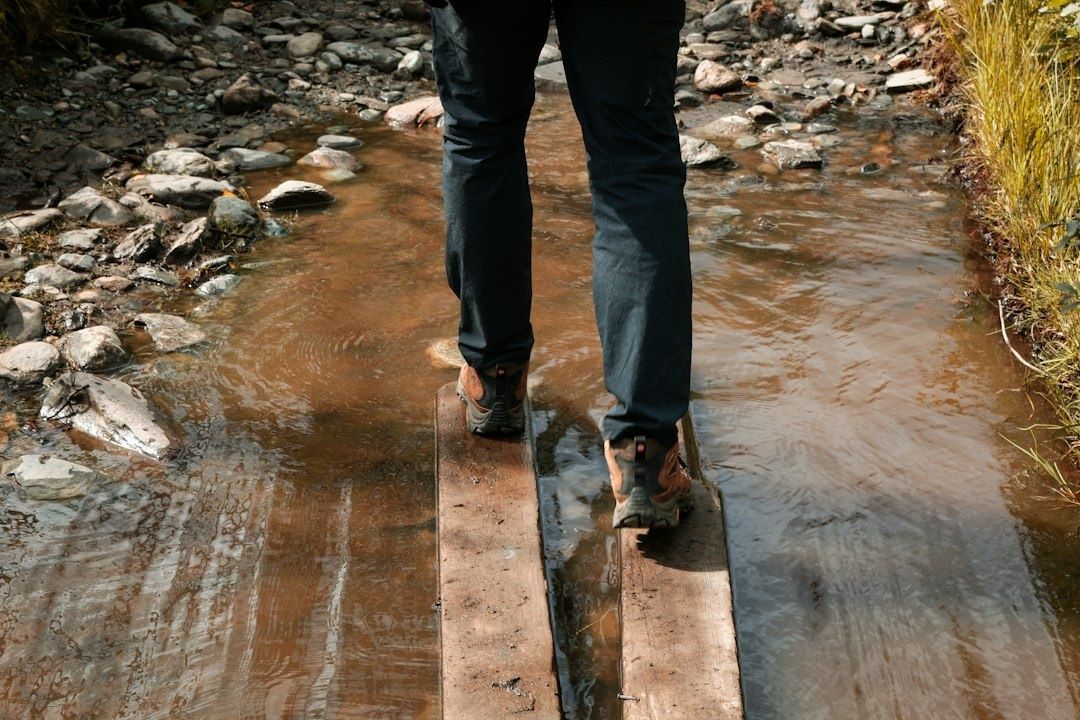
Rubber Chemistry and Tread Architecture on Slime and Silt
Wet grip begins with the rubber itself. Softer, climbing-influenced compounds can deform around tiny irregularities in granite and sandstone, creating more intimate contact than a hard, durable sole. That microscopic conformity is valuable on polished rock, but it comes with a cost: soft rubber generally wears faster, can roll over sharp edges and may lose performance when used for long miles on abrasive ground. The best compound is therefore not simply the stickiest available. It is the one that balances friction, durability and the temperatures expected on the route.
Tread shape matters just as much. Fine siping creates additional edges and channels that help a sole maintain contact as water moves across the rock. Broad contact areas can work well on smooth slabs, while multidirectional lugs are more useful when the route includes mud, gravel or loose banks. The sole must also shed contamination. A tread packed with fine sediment cannot make reliable contact, no matter how advanced the rubber chemistry may be.
- Sticky rubber: Best suited to polished wet rock, where close surface contact matters more than deep penetration.
- Siped surfaces: Useful when thin films of water and algae interrupt friction between sole and stone.
- Open lugs: Better for mud, gravel and soft approaches because they clear more readily.
- Studs or cleats: Helpful on particularly smooth, steep or fast-water terrain, but noisier, less comfortable for walking and potentially damaging to boats or hard surfaces.
Traditional felt remains relevant in some wading environments because its broad, fibrous surface can grip algae-covered submerged rock exceptionally well. It is not a universal answer. Felt absorbs and retains moisture, can dry slowly, and may carry microscopic aquatic invasive species between waterways. Restrictions and bans vary by state, park and fishery, so regulations must be checked before use. Rubber soles are generally more versatile for hike-in approaches and mixed terrain, while felt may still outperform them on a route dominated by slick submerged rock where little walking is required.
Hydrodynamics and Drainage Systems That Keep You Mobile
Waterlogged footwear becomes heavy in a way that is easy to underestimate at the start of a crossing. Every step lifts water, moves it through the upper and pushes it against the foot. That repeated load increases effort, reduces precision and accelerates fatigue, particularly in cold current where muscles are already working to maintain balance. Waterproof construction is often the wrong priority for a route that involves deliberate wading. A non-waterproof upper with fast drainage can leave the foot wet, but it avoids carrying a reservoir of water for the rest of the day.
Drainage design should match the debris profile. Perimeter ports and strategically placed openings allow water to escape as the foot lands and flexes. Fine mesh can help prevent stones and sand from entering, although extremely fine material can clog when a crossing includes silt. A low-profile river shoe may evacuate water quickly through its mesh and ports, while a purpose-built canyoneering boot may use a more protective upper that drains more gradually but keeps gravel away from the foot and supports a thicker neoprene sock.
Sediment behaves differently from clear water. Fine particles can migrate through seams, collect beneath the insole and create pressure points. Coarser gravel can wedge beside the heel or under the toes, changing the way the foot loads the ground. The same principle used in formal ground assessment applies here: identify the substrate, distinguish firm material from loose deposits and expect conditions to vary over short distances. The PennDOT geotechnical investigation guidelines show how carefully soil, rock and discontinuities are documented in field work, a useful reminder that riverbed texture deserves deliberate attention rather than guesswork.
- Choose rapid drainage where the route includes frequent wading, swimming or boat transitions.
- Choose debris resistance where sand and small gravel will remain in the shoe for hours.
- Use neoprene socks when warmth, cushioning and abrasion protection matter more than a completely dry foot.
- Stop and clear trapped debris early. A small pressure point can become a blister, altered stride or balance problem.
Structural Integrity, Lateral Ankle collars, and Rock Strike Defense
Technical canyoneering footwear is built around controlled support. Higher collars and reinforced uppers help resist a sudden lateral roll when a foot lands on an angled ledge or disappears into a slot beside a boulder. They also reduce the chance of direct strikes from rock and provide a barrier against abrasion during chimneying, scrambling and rope work. This armour is particularly valuable when the foot is loaded sideways, a movement that a low-profile water shoe may not manage well.
The trade-off is mobility. Low shoes feel nimble, pack small and make it easier to sense the ground, which suits paddlers, packrafters and aquatic hikers moving through shallow water or climbing into a small boat. They usually offer less ankle restraint, less protection from wedged feet and less room for thick thermal socks. Reinforced wading boots provide more structure and can be comfortable over a full day, but weight, bulk and slower drainage become noticeable during long swims, deep crossings or steep approaches.
Routes such as the Zion Narrows combine cold water, polished rock, sand, sediment and current, so footwear needs to provide traction, warmth, drainage, debris resistance and support rather than one isolated feature. Before entering a demanding river corridor, review the official Zion Narrows guidance, including current access and safety information. High-cut boots with room for neoprene socks are often the more protective option on technical canyon routes, while a lighter wet-grip shoe may be appropriate for controlled paddling or less committing riverbed travel.
Head to Head: Wet Grip Boots Compared to Canyoneering Shoes
Wet grip boots and technical canyoneering shoes overlap, but they are designed around different priorities. A wet grip boot typically favours efficient traction, fast water release and a lower, more flexible profile. A canyoneering shoe accepts additional weight and stiffness to provide better ankle control, rock protection and compatibility with thermal socks. Neither category is automatically safer. The safer choice is the one that fits the route”s force, exposure and movement demands.
| Terrain factor | Wet grip boots | Technical canyoneering shoes |
|---|---|---|
| Friction | Strong on wet rock when fitted with soft, well-siped rubber; performance varies on mud and loose gravel. | Usually combines sticky rubber with a tread designed for mixed canyon surfaces. |
| Structural protection | Light to moderate ankle and toe protection, prioritising dexterity. | Higher collars, reinforced uppers and firmer platforms resist rolls, strikes and abrasion. |
| Drainage velocity | Often very fast through mesh uppers and drainage ports. | Still designed to drain, but protective materials may slow evacuation slightly. |
| Weight | Lower weight reduces fatigue during paddling, scrambling and repeated crossings. | Heavier, especially with armour and thicker soles, but more supportive under load. |
| Stem capability | Good for shallow water, boat use and agile movement; limited for severe wedging or high-consequence rolls. | Better suited to technical slots, exposed boulder movement, rappels and routes requiring robust foot placement. |
For kayaking and packrafting, prioritise a secure fit, low bulk, dependable wet traction and quick drainage. For gorge scrambling, canyoning and routes with rappels or narrow slots, prioritise ankle structure, toe protection, sole stiffness and compatibility with a neoprene sock. For wet wading, assess the amount of walking outside the water. A felt or studded system may help on a specialised fishing route, whereas a versatile rubber sole is usually more practical when the day includes trails, banks and rocky access points.
Field Decision Framework for Choosing Your Footwear Match
- Read the geology. Identify whether the route is polished granite, rough sandstone, shale, mud or mixed alluvial gravel. Algae-covered stone calls for dependable wet friction and a tread that does not clog immediately.
- Map the water. Note expected depth, current speed, swimming sections, water temperature and the number of entries and exits. Repeated immersion favours fast drainage; cold, prolonged wading raises the value of neoprene socks and a supportive upper.
- Account for technical movement. Rappels, stemming, chimneying and submerged boulder crossings demand more ankle restraint and impact protection than a flat river walk or a short paddle carry.
- Build the complete system. Test the shoe with the intended socks, debris gaiters and insole. Check heel hold, toe room, drainage, sole stiffness and whether the foot remains secure when the shoe is wet.
Do not wait for the hardest section to discover that the sole is too soft, the collar rubs or the shoe fills with grit. Test friction early on a low-consequence rock, place the whole sole rather than relying on a pointed toe, and keep three points of contact when the current pushes across the leg. If the route requires a swim, make sure the footwear remains attached without relying solely on loose laces or a collapsing heel.
Inspection matters as much as selection. Look for worn siping, rounded lugs, separated rubber, stretched lace hardware and compressed midsoles. Clean sediment after each trip, dry the footwear fully and follow local rules for felt or other materials that may transport aquatic organisms. Gear that performs well on one river can become a liability on another, so treat every outing as a fresh assessment of water, rock and consequence.
Equip Your Feet for Confident Strides in Unforgiving Waterways
Wet grip boots deliver agility, fast drainage and close contact with slippery rock. Technical canyoneering shoes add ankle restraint, toe protection, debris resistance and a more stable platform for demanding canyon movement. The dividing line is not marketing language. It is the amount of lateral force, rock impact, cold exposure and technical movement your feet must manage.
Before setting off, match rubber friction to the geology, drainage to the amount of immersion and structural support to the consequences of a misstep. Inspect the footwear, test it wet, clear sediment before it becomes a problem and move deliberately when current or polished rock removes your margin for error. Solid footing begins with the right tool, but safe progress comes from reading conditions, respecting the water and building confidence one controlled step at a time.